Energy renovation: half of Belgian landlords finance renovations with their own funds
Property investors in Belgium are facing increasingly stringent regulatory requirements regarding energy renovation. According to the Sustainable Real Estate 2025 survey, Belgian landlords are highly engaged in improving the energy performance of their properties, driven less by sustainability concerns than by a desire to increase the value of their assets and improve their competitiveness in the rental market.

The Sustainable Real Estate 2025 study1, conducted by Profacts in collaboration with BNP Paribas Fortis among 2,300 Belgian adults, including 300 landlords, reveals a high level of engagement in energy renovation projects. No fewer than 95% of landlords have already undertaken, are currently carrying out or plan to undertake measures to improve the energy efficiency of their properties.
Beyond this aggregate percentage, the intensity of the commitment is striking: 46% of landlords are currently carrying out energy renovation work, compared with just 31% of owner-occupiers — a 15-percentage-point gap that reflects much stronger pressure to act in the rental sector. Increasingly demanding regulations are a key factor driving this trend.
The measures most commonly implemented or planned by landlords focus on improving the overall performance of buildings:
- Roof insulation (51% already completed)
- High-performance glazing (45%)
- High-efficiency boilers (42%)
- Façade insulation (41%)
Landlords are also investing in active energy management solutions, such as ventilation systems (32% already installed), energy management systems (33%), and solar panels (32%). This reflects a more integrated approach to improving the performance of their property portfolios.
Asset value and legal compliance: the two key drivers for landlords
The motivations of landlords and owner-occupiers for investing in the sustainability of their properties differ significantly. The main motivation is to increase the property's value, cited by 55% of landlords compared with 39% of owner-occupiers. This is followed by improving the EPC certificate rating (52%), complying with legal obligations (48%) and increasing rent levels or rental value (46%).
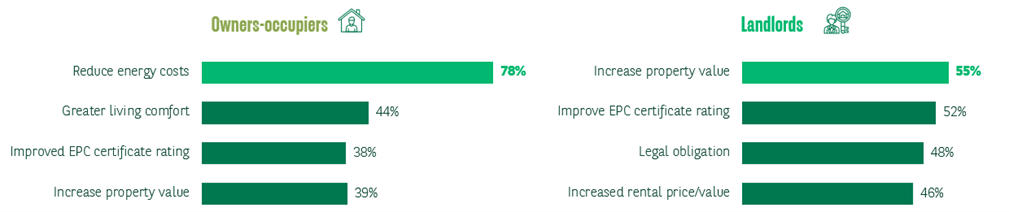
These findings highlight a clear investment rationale: renovation is seen as a means of enhancing asset value, improving competitiveness in the rental market and complying with regulatory requirements. While environmental considerations are present, with 35% mentioning reducing climate impact, these appear to be secondary to economic and legal considerations.
Financing: bank loans almost level with own resources
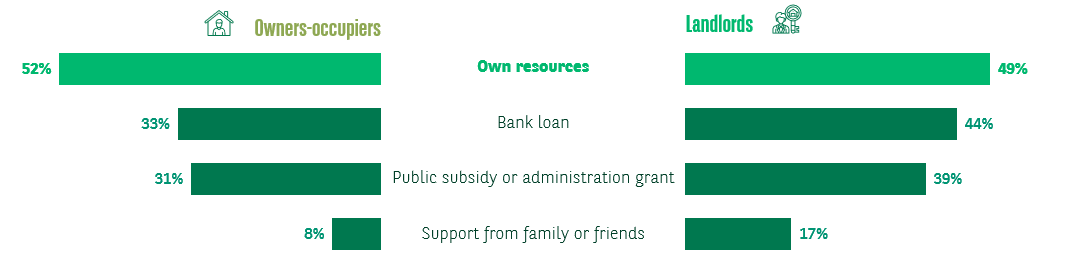
The survey confirms that landlords rely significantly more on external financing than owner-occupiers and that banks already play a central role in this process. Nearly half of landlords (49%) finance energy renovations from their own resources, while 44% use a bank loan – a difference of just five percentage points between the two funding sources. By comparison, the gap between owner-occupiers' own resources (52%) and bank loans (33%) is 19 percentage points.
Government grants and subsidies are the third most important source of funding for landlords (39%), ahead of support from family members (17%). Combining several funding sources is common, illustrating the complexity of the financing arrangements that landlords often need to put in place to carry out their renovation plans.
“Belgian landlords are therefore at the forefront of the energy transition of Belgium’s housing stock and expect support from their bank that goes beyond simply providing a renovation loan’, explains Laurent Loncke, Head of Retail Banking at BNP Paribas Fortis. That is why BNP Paribas Fortis has developed a complete ecosystem to support landlords throughout their renovation journey. Our advisors help them build a financing plan that reflects their property and environmental goals, guide them towards available grants and subsidies, and help them understand the regulatory obligations that apply to their properties.”
Regulatory obligations: landlords are informed, but blind spots remain
One of the study’s key findings concerns landlords’ awareness of future legal obligations. Landlords demonstrate a higher level of knowledge in this area than owner-occupiers, although gaps remain, with potentially costly consequences. The target EPC certificate level that the entire residential housing stock must achieve by 2050 is known by 73% of Flemish landlords and 77% of landlords in Brussels, compared with 51% and 55% respectively among owner-occupiers. This gap of 20 to 22 percentage points confirms that landlords follow regulatory developments more closely, which is consistent with the fact that legal compliance ranks as their third most important motivation for investing (48%).
Landlords are also much more likely to know the exact EPC rating of their properties. In Flanders, 79% know the precise rating of at least one of their rental properties, compared with only 41% of owner-occupiers for their main residence. In Brussels, the difference is 34 percentage points (86% versus 52%). In Wallonia, it stands at 25 percentage points (62% versus 37%).
These figures reflect a legal reality: EPC ratings must be stated in property advertisements and rental agreements, meaning landlords must have an accurate understanding of their properties’ energy performance.
The role of tenants in accelerating change
The survey also captures tenants’ views of their landlords. According to 64% of tenants, their landlord’s approach to sustainable investment is reactive, meaning action is only taken in response to complaints or legal obligations. Just 10% describe their landlord as highly proactive.
This external perspective sends a clear signal that landlords cannot ignore. In a rental market where energy performance is becoming an increasingly important factor for prospective tenants, and where less efficient properties risk losing both attractiveness and rental value, a proactive approach to sustainability is becoming a genuine competitive advantage.
1 About the study: Sustainable Real Estate 2025 was conducted by the market research agency Profacts. The study was based on a quantitative online survey (CAWI methodology, syndicated multi-client survey) carried out between 7 November and 10 December 2025 among three representative samples of the Belgian population aged 25 and over: owner-occupiers (n = 1,500), tenants (n = 500) and landlords (n = 300). The samples were weighted according to age, gender and region.