Higher education: 1 in 4 Belgian parents seek extra income to fund their children’s studies
Parents often make considerable sacrifices to fund their children’s higher education, such as cutting back on other spending, dipping into savings or even looking for additional income. For most university and college students, parents are the main source of financial support, whether it's for tuition fees, accommodation or study materials. However, students often have to contribute themselves, particularly when it comes to going out or everyday food costs. A student job helps many young people cover these additional expenses. The choice between living at home and moving into student accommodation is often dictated by finances, and not all students are happy with their living arrangements. These are the findings of a survey of 300 Belgian parents of higher education students, conducted by research agency Profacts on behalf of BNP Paribas Fortis.

As the new academic year approaches, many students and their parents are beginning to plan their budgets. The vast majority (85%) of parents with children in higher education take at least one specific measure to help fund their child’s studies. Some 59% have to cut back on other spending to cover these costs. Among parents of students living in student accommodation, this figure rises to 74%, significantly higher than among parents of students living at home (55%).
Almost six in ten parents (58%) have saved specifically to give their child the opportunity to obtain a higher education qualification. Just over half (52%) also use savings that were not specifically intended to cover study costs. A quarter (26%) of parents have looked for an additional source of income, such as a flexi-job. Just over one in ten parents (12%) say they have taken out a bank loan to fund their child’s studies.
Studies are mostly paid for by parents
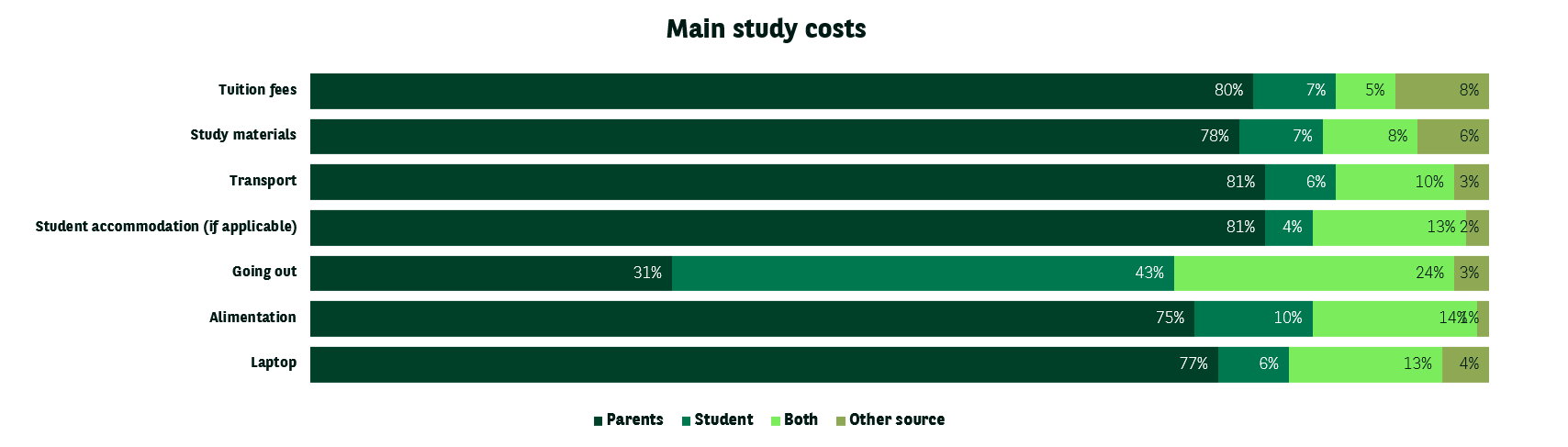
It is perhaps unsurprising that many parents have to make a significant financial effort when their children enter higher education, as parents cover the main study costs for 62% of students. These costs include university or college tuition fees, study materials, transport and a laptop. Only 29% of students have to contribute towards at least one of these four expenses. The remaining 9% do not have to contribute at all. In these cases, parents cover part of the costs, with the remainder coming from another source of funding, such as a study grant.
More than eight in ten parents (81%) whose children live in student accommodation also cover their accommodation costs. Only 4% of these students pay the rent entirely themselves, while the cost is shared between parents and the student in 13% of cases. When it comes to everyday food costs, three-quarters (75%) of students can rely on their parents to foot the bill. The remainder have to pay for at least some of their own food and drink. This is more common among students living in student accommodation (32%) and those with a job (30%).
In addition, 79% of students regularly receive pocket money. Among those living in student accommodation, this figure rises to 91%, compared with 75% of those living at home. On average, they receive €250 and €130 per month respectively.
Going out
Of course, student life isn’t all hard work – there’s time for fun, too. The survey shows that parents are less inclined to fund their children’s social lives. Only one in three parents surveyed (31%) say they do so. Two-thirds say their child has to cover these costs either entirely (43%) or partly (24%).
The survey results also reveal a clear difference between students living in student accommodation and those living with their parents: more than half (53%) of those in student accommodation pay for their own social activities, compared with just 40% of those living at home.
Student jobs
Many students fund their social lives through a student job. Almost six in ten (58%) have one. According to the parents surveyed, 57% of students with a job pay all their own costs associated with going out. By comparison, only 6% of this group have to pay their tuition fees entirely themselves, while 8% fully cover the cost of their own study materials.
Student accommodation or living at home?
Three-quarters of the parents surveyed (74%) say their children in higher education live at home. The remaining quarter live in student accommodation (24%) or a flat (2%). Not all students are equally happy with this arrangement: one in six (16%) of those living with their parents would prefer to live in student accommodation. The good news for this group is that around three in ten parents (29%) say their child will move into student accommodation in the future.
According to parents, there are two main reasons why their children do not live in student accommodation. The first is cost: more than four in ten parents (44%) say it is too expensive. The second is the location of the campus: 43% of parents say it is accessible from home, making student accommodation unnecessary.
BNP Paribas Fortis budget tool
The budget analysis tool in Easy Banking App provides BNP Paribas Fortis customers with a dynamic overview of their finances. With features including graphs showing income and expenditure, as well as an automatic breakdown into spending categories, customers can easily keep their budget under control and identify areas where they could save money.
For each spending category, customers can create their own ‘budget meter’. This allows them to set a maximum budget for specific expenses, such as ‘study materials’, ‘going out’ or ‘food’. It also makes it easy to compare spending in these categories from one month to the next.
“Our survey shows just how far parents are prepared to go to give their children every opportunity,” says Laurent Loncke, Head of Retail Banking at BNP Paribas Fortis. “Our advisors are ready to help customers draw up a realistic budget for study costs, tailored to their personal circumstances. Having a clear overview of income and expenditure is essential. With the budget analysis tool and budget meters in Easy Banking App, customers can easily keep track of their spending and make adjustments where necessary.”
Methodology
The online survey was conducted from 13 to 19 August 2026 among a representative sample of 300 Belgian parents of students currently in higher education or due to start higher education this year.